
Humans of POP: Adilet Aitmatov, Front-end Developer, Prague
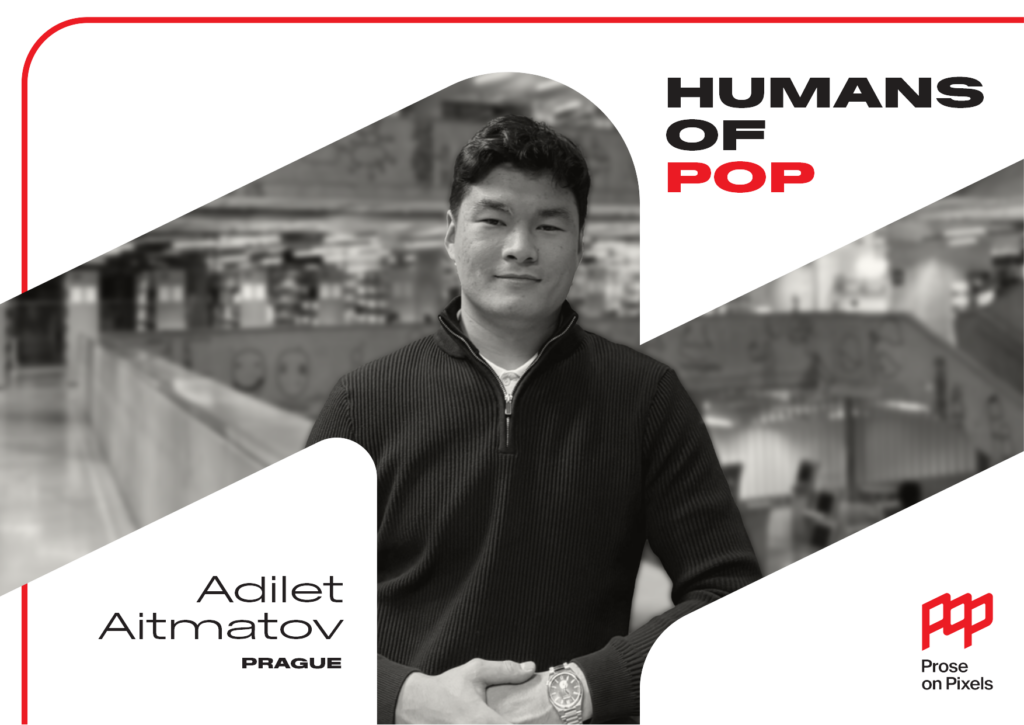
Is there a way to make web banner creation more efficient? Adilet Aitmatov, Frond-end Developer at POP Prague, thought so — leading him to create BannerBee, an AI-powered program that streamlines a previously repetitive process. Adilet combines a love for problem-solving with a passion for coding to create tools that make everyday work faster, smarter, and more intuitive. “I wanted to build things for a living,” he says. Today, that’s exactly what he’s doing.
From Bishkek to Prague, Adilet’s journey has taken him across continents and cultures, shaping his perspective and the way he approaches his work. Starting with a passion for coding during his school years, he quickly turned that interest into hands-on experience, working on mobile apps, video games, and more before joining POP. Today, he’s focused on building internal tools — often powered by AI and inspired directly by the needs of his colleagues — that make workflows faster, smarter, and more intuitive.
Keep reading to hear how Adilet is rethinking automation, building tools like BannerBee, and helping teams spend less time on repetitive tasks — and more time on creativity.
A bit about your story: where were you born, where did you live most of your life, and what/where did you study?
I was born in Bishkek, Kyrgyzstan, in 2001, and spent most of my years there. My time in Kyrgyzstan was defined by two main aspects: a career in competitive sports and discovering the world of code.
While studying at the Ecological-Economical Lyceum 65, I spent four years at a sport shooting club. I discovered a deep passion for the discipline and focus that sport requires. It led to several achievements, including becoming a Champion of Bishkek, a National Champion of Kyrgyzstan, and earning the title of Candidate Master of Sport. Competing in international championships taught me how to stay calm under pressure, a skill that surprisingly comes in handy when dealing with tight deadlines!
Toward the end of secondary school, I took a coding course at Professional Lyceum 98. I immediately fell in love with the logic of programming. I kickstarted my career at Namba (a regional alternative to Bolt), where I got my hands on everything from mobile apps and websites to video games. That experience confirmed it: I wanted to build things for a living.
In late 2019, I moved to the Czech Republic to take my education further. I enrolled at the Czech University of Life Sciences in Prague in 2020. My time at university has been an incredible gateway to the world; thanks to their exchange programs, I’ve had the chance to live and study at INHA University in Incheon, South Korea, and the University of Cyprus in Nicosia. This journey of discovering new cultures has shaped how I see the world and widened my vision.
What is your role at POP? What does a typical day look like for you?
I started as a Front-end Developer building HTML5 banners and working on client websites. Today, my focus has shifted inward to development of Internal Automation tools. I build the tools that speed up processes within POP.
My day is all about problem-solving through conversation. I talk to colleagues across different departments to understand their pain points and brainstorm ideas for automation. Once I identify a need, I prototype a solution; if it works, it becomes a permanent part of our internal toolkit. I’m constantly balancing these new “experiments” with the development of our ongoing automation projects.
When did you first become interested in digital tools and development?
It started during my final year of school at Professional Lyceum 98 in Kyrgyzstan. I took a coding course and immediately realized it was the career path I wanted to follow.
My interest quickly turned into professional experience at Namba, where I built everything from mobile apps to video games. That early variety taught me how powerful digital tools can be for solving real-world problems — a mindset I still bring to POP today when building internal automations.
What is BannerBee? When did you first start working on it, and what inspired you to do so?
BannerBee is a generator of animated web banners powered by AI. I started working on it while I was on exchange program in Cyprus. There, I participated in a hackathon organized by the Bank of Cyprus, where my Czech mate and I built a banking AI chatbot. We didn’t win, but we were really close to getting a prize. That experience opened my eyes to how powerful AI can be, and I’ve been thinking about where to apply it ever since.
Then one day we received a request for 20 animated HTML5 banners. The animation was simple and repetitive. I made one of them by coding it in JavaScript, then asked AI to create the resized versions. The result was perfect; it never made a single mistake. At that moment, I realized I needed to create a tool that would do my job.
What we do now is export images, upload them to BannerBee, select a template, and click generate. We went from one hour to five minutes per banner!
How did you approach designing an interface that feels intuitive for people with less technical knowledge?
My approach to interface design is rooted in a minimalistic style. I try to keep the user’s display clean and focused, ensuring they aren’t overloaded with unnecessary information or complex settings. To make sure everything is intuitive, I collaborate with my designer colleagues; I approach them for advice on the best placement for certain elements.
What other tools have you developed in your time at POP?
Verif.AI: An AI-powered QC tool that checks content for cultural, legal, and brand guideline compliance. My favorite feature is the Guideline Helper — it’s like having a search engine for our brand books that gives you instant, accurate answers with a screenshot of the page from the guidelines. The idea for this tool came to me from my manager, Joseph DeLaMure.
AdiFix: A Figma plugin designed for rapid localization of static banners. Designers mark the layers that need localizing, upload a CSV file with all translations, and the plugin generates fully editable frames with the correct text. I’m especially proud that this was the first internal Figma plugin published within the Havas network!
BriefingNinja: Currently in development, this tool helps Project Managers consolidate understanding for larger client briefs. Building on an initial concept by my former colleague Majd Qasem, I’m improving the logic and accessibility to turn massive, complex Excel tables into structured, actionable information in seconds.
What role did AI (like Gemini) play in shaping the product experience of BannerBee and other tools? How did you decide which model to use?
It was an easy choice. Since I use Firebase (part of Google Cloud) for development, it was really straightforward to connect Gemini through Vertex AI, as it performs well for the demands of the tool in a cost-effective way.
When developing a tool, how do you balance automation with flexibility and creativity?
I believe the best tools should handle the repetitive, “boring” parts of a job without taking away creative control. For me, automation isn’t about replacing the person; it’s about automating the “friction” so they can focus on the “function.” This way, the tool does the heavy lifting, but it leaves the final, creative part of the project for human hands. Success is when a tool feels like a super-powered assistant that gives you more time to be creative.
What is your process for developing a tool, from ideation to launch? How did your role at POP influence your decision to create BannerBee, and how has the creation of BannerBee changed your role at POP?
I’m constantly observing how we work and talking to my colleagues across different departments to see where we can improve. Many ideas come directly from them; I simply listen to them to identify their main pain points. Once we identify the problem, I sit down with them to dig deeper and gather their specific requirements for the tool.
After I have all the information I need, I start by building a rough schema to map out the application’s structure. From there, I develop a prototype to test the concept and see if the idea is technically feasible to implement. Once I check the results and confirm the prototype works, I begin refining the tool and building the rest of the functionality until it’s ready to become part of our internal toolkit.
Looking ahead, how do you see AI-powered tools like BannerBee shaping the future of the advertising industry, and how might they change the way brands and individuals create, personalize, and scale content?
I believe that by creating small, focused tools that each solve a specific task, we can eventually build a pipeline where these tools talk to each other and work independently. They’re already simplifying our jobs by handling most of the repetitive, mundane work.
Quick ones:
Do you listen to music while working – and if so, what’s your go-to album?
I prefer podcasts over music — my favorite is “Kuji Podcast.”
What fuels your workdays – coffee, tea, chocolate, or something else?
Gym during lunch time, plus sauna once a week. No coffee — only water!
If you get “writer’s block” when coding, what do you do to reset?
We have a nice table tennis setup in the office. I love playing with my colleagues when I feel like I’m getting mentally tired.
Humans of POP is our storytelling series, created to shine a light on the people making it all happen behind the scenes. Our people are at the heart of everything we do – and this series is all about hearing from them directly. Across continents and cultures, these stories remind us how much we can learn from those around us.
Comments are closed.