
Leadership at Speed and Scale: An Interview with Joris Knetsch, EVP, APAC
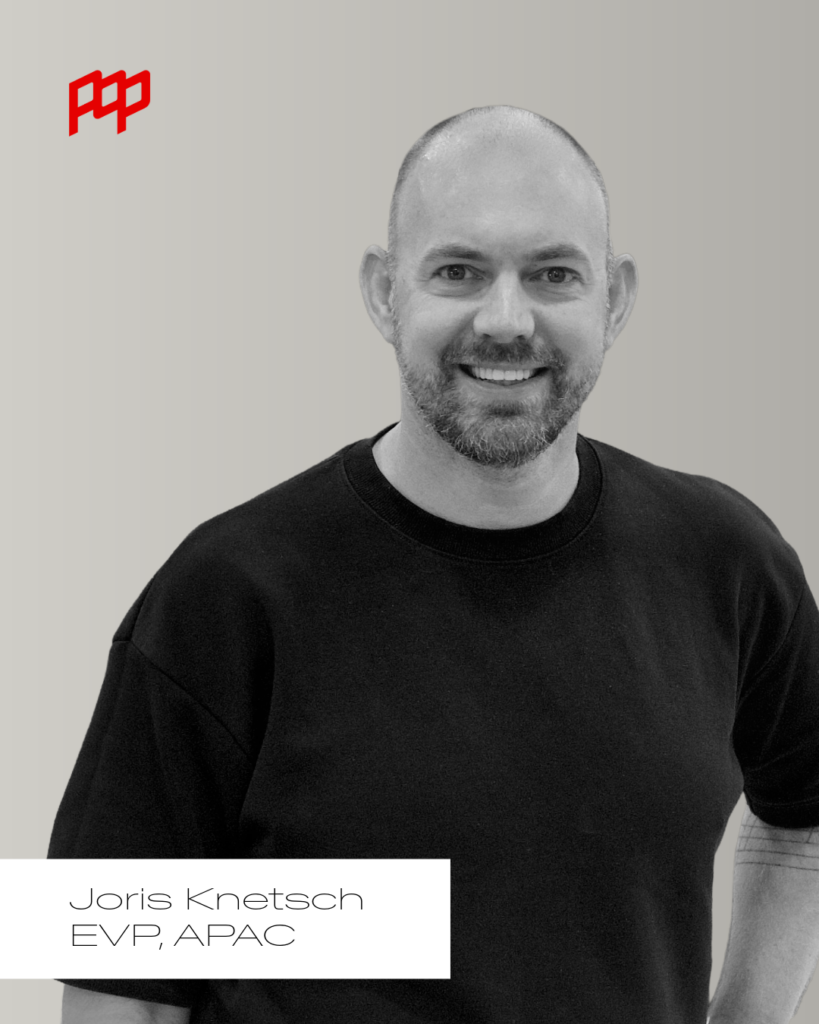
With a long career of production experience and APAC regional know-how, Joris Knetsch joined POP to build our APAC footprint as Executive Vice President. Following his roots in innovation, entrepreneurship, and digital production, it all started when he moved from Amsterdam’s boutique agency scene to Singapore, where he set up a Southeast Asia production operation from the ground up. Early last year, he took on the challenge of launching and scaling POP across one of the world’s most diverse regions — a role that blends commercial growth with hands-on craft.
In this conversation, Joris shares his leadership philosophy — a “lead by doing” approach that mixes Dutch directness with Asia’s nuanced communication — and explains how that mindset powers a truly borderless model. He breaks down APAC’s dual role in our network, why Vermeer.ai matters as a bridge between creative ambition and production reality, and how to deliver personalization that means something, not just frequency at scale.
Here, we uncover his insights on building a high-velocity, human-led, AI‑enabled production business — and his unique view on using technology to say yes to ideas teams couldn’t have shipped before.
Can you tell us about your career journey that led you to heading POP in the APAC region?
Sure! It depends how far back we want to go… But when I was a little kid… 😊
Jokes aside, I’ve got a fairly long background in advertising, production and innovation. I ran my own company at one point, worked in the innovation team of a bank during my International Business Management studies, then joined a boutique agency in Amsterdam about 15 years ago as project director and digital lead. That’s where my advertising career actually started.
A couple of years later I moved to MediaMonks, the Netherlands’ well-known digital production agency. They’re the ones who sent me to Singapore nine years ago to set up their production business in Southeast Asia. I did that, had a great run, and two years ago it was time to move on. That’s when I met Paul Ward (CEO, UK & Global President at POP), and we got talking about setting up POP in APAC. It sounded like an awesome challenge, so I started this role early last year. It’s hard work, but I get to see the business grow and new people join the team, and I’m loving every bit of it.
How would you define leadership, and how has that definition guided you in your career?
My leadership style is leading by doing: a mix of direct Dutch leadership, where I expect open feedback from everyone, and the more subtle communication style of Asia, where sometimes you have to actively ask people what they think to get the information you need.
I’m definitely not an authoritative leader — I’m more someone who’s approachable and involved. I like to get my hands dirty, as they say. I’m pretty extroverted and direct, probably due to my upbringing, which means I speak my mind — whether it’s about an idea I like or something I think could be done better. That caused a bit of friction in Asia early on, but over time I’ve learned to navigate it, so my style now sits somewhere in the middle: I read the room, package my messages carefully, but I never hold back either.
And even though I like to stay involved, I’m not a micromanager. My job is to give my team the stage to shine. If they’re successful, I’m successful.
How would you describe APAC’s role within our “borderless” approach?
I think APAC plays two roles in POP’s borderless approach. First, you need to understand how diverse, or fragmented, APAC actually is. Australia, Singapore, Hong Kong, Japan and Korea are wealthy markets with some genuinely interesting clients, though Japan and Korea in particular have a tough, competitive advertising ecosystem dominated by in-housing and family-owned companies. Then you’ve got the up-and-coming economies: Malaysia, Thailand, Indonesia and the Philippines, with big populations and significant growth potential.
Roughly speaking, we focus on both spectrums with different strategic approaches. That’s working well, especially since Malaysia will bring great production and design talent, and Thailand is fantastic for film shoots.
Connect that to a borderless approach and you’ll see us servicing Australian- or Singapore-based clients through studios in Prague or even the UK, while our Malaysian team will deliver efficient, high-quality production for clients from anywhere in the world.
Of course, my starting point is always to source production within the region first, since it makes logistics a lot easier, mainly because of time zones. But our borderless approach is also crucial within APAC itself: Australia, North and East Asia, and Singapore can act as feeders into our production studio in Malaysia.
Looking back, if you could choose one life-changing moment or decision in your journey, what would that be?
I guess there are always several moments that define where you end up. For me, it was leaving banking and heading back into advertising. I quickly realised production suited my hands-on approach perfectly, which is why the move to MediaMonks felt so natural, and so did my contribution to their business there. That’s what opened the door for my husband and me to move to Singapore. I’m really glad we did, because we both love living in Asia. Without that decision, I don’t think I’d ever have ended up in this role.
What is your role at POP? What does a typical day look like for you?
I’m Executive Vice President APAC. It’s a fairly general title, but a relevant one, because what I do is just as broad. My work ranges from introducing POP’s services and capabilities to Havas agency partners and their clients, to integrating existing production teams, to connecting with external suppliers to build partnerships.
Then there’s the more down-to-earth side: I manage accounts, projects, finances, and the aspects of doing international business and represent production in the Southeast Asia leadership team. So yes, I would say it’s a pretty diverse spread.
A typical day starts around 9:30 or 10 in the morning, since I try to get a workout in before work. I focus on Australia first because of the time difference — by the time I start my day it’s already noon or 1pm for them. From 4pm onwards I’m on European catchups, which depending on the day can run well into the evening or night. So, managing work-life balance matters too, which is why I try to stack most of my European meetings early in the week, leaving Thursday and Friday evenings free for a little bit of a social life.
You’ve worked at other advertising agencies throughout your career. How does POP’s approach differ?
What I like about POP is that we’re down-to-earth, production-focused people who also happen to have a lot of advertising experience. So we don’t just focus on production — we actually know how to use it to push a creative idea further. We’re not in the business of just producing more stuff (and more waste!), we look at production through a creative, media and often data lens too.
That’s quite different from the companies I worked for before, they were usually stuck in just one of those pillars. They’d promise clients they could combine disciplines, but in reality they couldn’t really pull it off. It’s that mix of left- and right-brainers, creative people and media people, combined with people who actually understand production, that makes POP pretty special.
Given your international experience, and POP’s positioning as a borderless network, what are some of the key differences and commonalities you’ve observed in leading diverse, multidisciplinary teams across various cultures?
When you move to Asia, things run at about 120%. Turnaround times are shorter, client expectations are higher, and communication channels are all over the place. Europe is diverse too, sure, but the distances between cultures here are bigger than anything I knew back home. Managing those differences is something you only really learn by living it, because everyone on these teams is “foreign” if you’re coming from Europe.
A recent example sums it up nicely. One of my clients briefs me over WhatsApp with email and phone calls interchangeably, often outside working hours — that’s just how business is done where they’re from. Then he got hold of a European colleague’s number and assumed the same rules applied. When he didn’t get a quick reply, he asked if he was being ignored. He wasn’t — he just didn’t know that in Europe, WhatsApp and Instagram are for friends, not business, and even a phone call usually gets a follow up recap by email. Once I explained it, he was relieved, because he hadn’t done anything wrong — it was just a different rulebook. Now he knows: he can message me anytime, anywhere, but if it’s Europe on the other end, send an email.
The overlaps matter just as much though. Craft people everywhere want their work to be appreciated. People who don’t speak up as loudly as we do in the West light up when you actually hand them the microphone. And our commercial teams love a client win just as much here as in Europe or the US. But there’s one difference I genuinely love: I think Asia leans collective in a special way. There’s rarely one winner — it’s the team that won, together.
Digital transformation has been a core theme in your career. What is your philosophy on integrating technology to not just improve efficiency, but to truly redefine business models and client value?
For me, digital transformation has never been about doing the same things faster. That’s just efficiency, and efficiency on its own gets boring fast. The interesting part is when technology changes what you can actually sell, not just how quickly you can deliver it.
Take what we’re doing with Vermeer.ai, our AI platform for hybrid productions. The easy pitch would be “we can shoot less and render more, so it’s cheaper.” That’s true, but it’s the boring version. The real shift is that we can now combine real human talent with AI generated environments in ways that simply weren’t possible before, which means we’re not competing on turnaround time anymore, we’re offering something clients couldn’t get from a traditional production house at all. That’s a different conversation with a client, and a different value exchange.
I see the same thing happening on the data and AI side more broadly. I tinker a lot with this myself: I run my own signal scanning setup at home that scores information using LLMs, purely as a personal project. It’s taught me that the technology is rarely the hard part — the hard part is figuring out what new business model that technology actually unlocks, and being honest about which parts still need a human in the loop. If you bolt AI onto an old business model you just get a faster old business model. If you use it to ask what a client actually values, and build the offering around that, you end up somewhere completely different.
So my philosophy, if I have to put a name on it, is that efficiency is a side effect, not the goal. The goal is to find the moment where the technology lets you say yes to something you couldn’t have offered a client before.
POP is at the forefront of the AI revolution, bridging the gap between creative and production. How are we harnessing AI to optimize the production pipeline, ensuring both innovation and efficiency across our markets?
The way I look at it, AI in production only matters if it does two things at the same time: make the work better, and make the work faster. If it’s just one of those, you haven’t actually changed anything.
Vermeer.ai is the clearest example of this for us. It’s our platform for hybrid productions, in which we’re able to combine human talent with AI-generated environments, and it sits exactly at the bridge between creative and production. The old way of working meant a creative idea would get watered down the moment it hit a restrictive production budget or a tight deadline, because building a fully real set or shooting in five locations costs time and money you don’t always have. Vermeer.ai lets us keep the ambition of the idea and still hit the brief, because we’re not constrained by what’s physically buildable or shootable anymore.
Across our markets this plays out differently depending on what each region is good at. Our upcoming Malaysian studio, for instance, will bring fantastic production and design talent, so that’s where future AI-assisted production work will happen, while a client relationship might sit in Australia or Singapore. The borderless model means we can plug AI tools into wherever the work is being made, not just wherever the client happens to be.
But I’m wary of the version of this story that’s just “AI makes things cheaper”, something we still see and hear in Asia a lot. That’s true, and it matters, but if that’s the whole pitch, we’ve reduced ourselves to a cost play. The more interesting question is what AI lets a creative team attempt that they wouldn’t have dared pitch before, because previously it would’ve been too expensive or too slow to make real. That’s where innovation and efficiency actually become the same thing instead of a tradeoff.
How do you see the future of content, creativity, and craft at scale? Where do you see the production world in the next years?
I think scale and craft have been treated as opposites for too long, and that’s the wrong framing. The real opportunity is using scale to make things more personal, not less.
Right now most “personalisation” in advertising means I looked at a pair of shoes once and now they follow me around the internet for three weeks, on every platform, in every browser tab, until I block them out of pure irritation. That’s not craft, that’s just frequency. I’d love to see us get to a point where personalised content actually means something is made with me in mind, not just retargeted at me. A video that reflects something genuinely relevant to me, that I’d actually choose to watch, rather than something I’m already reaching for the skip button before it’s finished loading.
That’s where I think production is heading in the next few years: towards content that’s tailored at scale without losing the craft that makes people want to watch it in the first place. AI and tools like Vermeer.ai make that possible from a production standpoint — you can generate variations, swap environments, adapt a story for different markets, without reshooting everything from scratch every single time. But the technology is only half the answer. The other half is still very human: knowing which story is actually worth telling, and to whom.
So I don’t see craft disappearing as production scales up, I see it moving. Less of it will sit in the physical execution, the lighting rig, the set build, the fifteen takes to get one shot right, and more of it will sit in the thinking that goes in before anything is even shot: the idea, the targeting, the judgment call on what’s relevant versus what’s just noise. The agencies and production companies that figure out how to keep that judgment sharp, while letting the tools handle the repetition, are the ones that will still be making things people actually want to watch, instead of things people have learned to ignore.
Want more from POP? Don’t forget to follow us on LinkedIn and Instagram to never miss a thing.
Comments are closed.